Does Greatest Common Factor Occur Again
Foundations
xiv Greatest Common Factor and Factor by Grouping
Learning Objectives
By the finish of this section, you volition be able to:
- Discover the greatest mutual gene of ii or more expressions
- Factor the greatest common factor from a polynomial
- Gene past group
Before yous go started, take this readiness quiz.
- Factor 56 into primes.
If yous missed this trouble, review (Effigy). - Find the to the lowest degree mutual multiple of 18 and 24.
If you missed this problem, review (Effigy). - Simplify
 .
.
If y'all missed this trouble, review (Figure).
Detect the Greatest Common Gene of 2 or More Expressions
Earlier we multiplied factors together to get a product. Now, nosotros volition exist reversing this process; nosotros will get-go with a production and so break information technology down into its factors. Splitting a product into factors is called factoring.
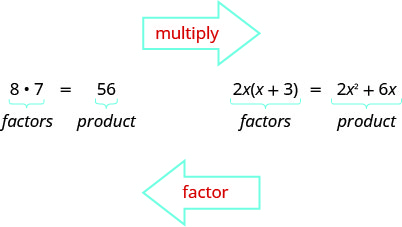
We take learned how to cistron numbers to find the to the lowest degree common multiple (LCM) of 2 or more numbers. Now we will gene expressions and find the greatest common factor of two or more than expressions. The method nosotros use is similar to what we used to discover the LCM.
Greatest Common Factor
The greatest common cistron (GCF) of two or more than expressions is the largest expression that is a gene of all the expressions.
First we'll find the GCF of two numbers.
How to Observe the Greatest Common Factor of Ii or More Expressions
Find the GCF of 54 and 36.
Solution
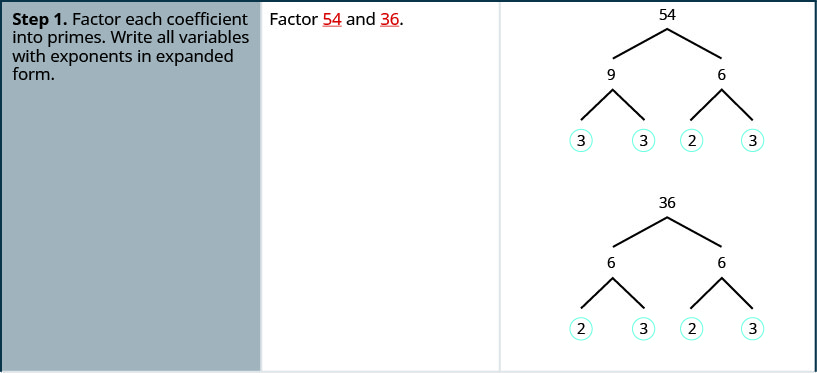



Find that, because the GCF is a factor of both numbers, 54 and 36 can exist written every bit multiples of 18.

Find the GCF of 48 and eighty.
16
Find the GCF of xviii and 40.
2
We summarize the steps nosotros use to find the GCF below.
Find the Greatest Mutual Factor (GCF) of two expressions.
- Factor each coefficient into primes. Write all variables with exponents in expanded grade.
- List all factors—matching mutual factors in a column. In each column, circle the common factors.
- Bring down the common factors that all expressions share.
- Multiply the factors.
In the showtime example, the GCF was a constant. In the adjacent two examples, we will become variables in the greatest mutual gene.
Find the greatest common gene of  .
.
Find the GCF:  .
.

Detect the GCF:  .
.

Find the GCF of  .
.
Find the GCF:  .
.

Find the GCF:  .
.

Detect the GCF of:  .
.
Find the greatest mutual factor:  .
.

Find the greatest common cistron:  .
.

Cistron the Greatest Common Factor from a Polynomial
Merely similar in arithmetic, where it is sometimes useful to represent a number in factored form (for instance, 12 as  in algebra, it can exist useful to correspond a polynomial in factored form. One way to exercise this is by finding the GCF of all the terms. Think, we multiply a polynomial by a monomial equally follows:
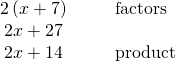
At present we volition commencement with a product, similar  , and end with its factors,
  . To do this we apply the Distributive Holding "in opposite."
We country the Distributive Property here just as you saw it in before chapters and "in contrary."
Distributive Property
If  are real numbers, then

The course on the left is used to multiply. The course on the right is used to gene.
So how practise you lot use the Distributive Property to factor a polynomial? Yous simply notice the GCF of all the terms and write the polynomial as a product!
How to Factor the Greatest Mutual Cistron from a Polynomial
Cistron:  .
.
Cistron:  .
.

Factor:  .
.

Gene the greatest common gene from a polynomial.
- Notice the GCF of all the terms of the polynomial.
- Rewrite each term equally a product using the GCF.
- Employ the "reverse" Distributive Property to factor the expression.
- Cheque by multiplying the factors.
Factor as a Noun and a Verb
We utilise "factor" as both a noun and a verb.
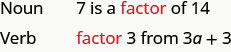
Cistron:  .
.
Factor:  .
.

Factor:  .
.

The expressions in the next example have several factors in common. Remember to write the GCF equally the product of all the common factors.
Factor:  .
.
Factor:  .
.

Factor:  .
.

Now we'll factor the greatest mutual factor from a trinomial. We start by finding the GCF of all 3 terms.
Factor:  .
.
Factor:  .
.

Factor:  .
.

Factor:  .
.
Gene:  .
.

Factor:  .
.

Factor:  .
.
Factor:  .
.

Factor:  .
.

Factor:  .
.
Factor:  .
.

Factor:  .
.

When the leading coefficient is negative, we cistron the negative out every bit office of the GCF.
Factor:  .
.
Factor:  .
.

Cistron:  .
.

Cistron:  .
.
Factor:  .
.

Factor:  .
.

Factor:  .
.
Solution
The GCF is the binomial  .
.
 | |
| Factor the GCF, (q + 7). |  |
| Check on your own by multiplying. |
Cistron:  .
.

Factor:  .
.

Factor by Grouping
When there is no mutual gene of all the terms of a polynomial, wait for a common gene in merely some of the terms. When there are four terms, a good style to get-go is by separating the polynomial into two parts with two terms in each function. So look for the GCF in each role. If the polynomial can be factored, you will find a common cistron emerges from both parts.
(Not all polynomials can be factored. Just like some numbers are prime, some polynomials are prime number.)
How to Gene by Grouping
Cistron:  .
.
Cistron:  .
.

Gene:  .
.

Cistron by grouping.
- Group terms with mutual factors.
- Factor out the common factor in each group.
- Factor the common gene from the expression.
- Check by multiplying the factors.
Cistron:  .
.
Solution
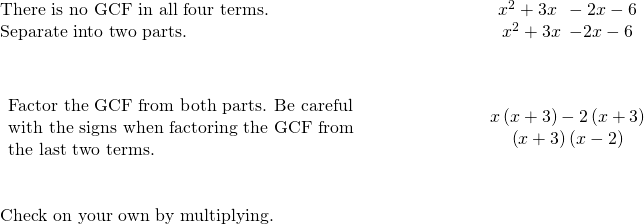
Factor:  .
.

Factor:  .
.

Key Concepts
- Finding the Greatest Common Gene (GCF): To find the GCF of two expressions:
- Cistron each coefficient into primes. Write all variables with exponents in expanded class.
- List all factors—matching common factors in a cavalcade. In each column, circumvolve the common factors.
- Bring down the common factors that all expressions share.
- Multiply the factors as in (Figure).
- Cistron the Greatest Common Gene from a Polynomial: To factor a greatest common factor from a polynomial:
- Find the GCF of all the terms of the polynomial.
- Rewrite each term as a product using the GCF.
- Use the 'reverse' Distributive Belongings to gene the expression.
- Check by multiplying the factors as in (Effigy).
- Cistron by Group: To gene a polynomial with 4 four or more terms
- Group terms with common factors.
- Factor out the common factor in each group.
- Factor the common factor from the expression.
- Check by multiplying the factors as in (Figure).
Practice Makes Perfect
Discover the Greatest Mutual Gene of 2 or More Expressions
In the following exercises, notice the greatest common factor.











Factor the Greatest Common Cistron from a Polynomial
In the following exercises, factor the greatest common factor from each polynomial.























Cistron by Grouping
In the following exercises, gene by grouping.












Mixed Practice
In the following exercises, gene.








Everyday Math
Area of a rectangle The area of a rectangle with length 6 less than the width is given by the expression  , where
  width. Factor the greatest mutual cistron from the polynomial.

Height of a baseball The height of a baseball game t seconds after it is hit is given by the expression  . Factor the greatest common factor from the polynomial.
Writing Exercises
The greatest mutual factor of 36 and 60 is 12. Explain what this means.
Answers will vary.
What is the GCF of  ? Write a general rule that tells y'all how to find the GCF of
  .
.
Self Bank check
ⓐ Later completing the exercises, use this checklist to evaluate your mastery of the objectives of this section.
ⓑ If virtually of your checks were:
…confidently. Congratulations! Y'all have achieved your goals in this section! Reverberate on the study skills you used so that you can go on to use them. What did you do to become confident of your ability to exercise these things? Be specific!
…with some help. This must be addressed quickly as topics y'all do not principal become potholes in your route to success. Math is sequential—every topic builds upon previous piece of work. It is important to brand sure yous take a strong foundation before yous motion on. Who tin can you inquire for help? Your fellow classmates and instructor are expert resource. Is there a place on campus where math tutors are bachelor? Tin can your study skills be improved?
…no – I don't get it! This is critical and y'all must not ignore it. You lot need to get help immediately or y'all volition quickly be overwhelmed. See your instructor as soon as possible to discuss your situation. Together you can come with a program to go you the help y'all need.
Glossary
- factoring
- Factoring is splitting a product into factors; in other words, information technology is the reverse procedure of multiplying.
- greatest common cistron
- The greatest mutual factor is the largest expression that is a factor of two or more expressions is the greatest common gene (GCF).
Source: https://opentextbc.ca/elementaryalgebraopenstax/chapter/greatest-common-factor-and-factor-by-grouping/
0 Response to "Does Greatest Common Factor Occur Again"
Enregistrer un commentaire